which of the following molecule has trigonal planar geometry
Table of Geometries
The VSPER theory detremines molecular geometries (additive, trigonal, trigonal bipyramidal, tetrahedral, and octahedral).
Scholarship Objectives
Practice the VSEPR manakin to determine the geometry of a molecule that contains no unsocial pairs of electrons connected the central atom.
Key Takeaways
Key Points
- Basically, the VSEPR fashion mode theorizes that regions of dissenting electric charge bequeath repel apiece other, causing them (and the stuff bonds that they form) to stay as FAR apart as possible.
- Molecular geometries allow the number of atoms and the number of lone pair electrons.
- The main geometries without lone couple electrons are: linear, trigonal, tetrahedral, trigonal bipyramidal, and octahedral.
Key Terms
- VSEPR Theory: a alchemy model used to predict the physical body of individual molecules based on electron-pair static repulsion
VSEPR Model
The valency shell electron pair repulsion (VSEPR) mold focuses on the bonding and nonbonding electron pairs lay out in the outermost (valency) shell of an atom that connects with deuce operating theatre more else atoms.
Fundamentally, the VSEPR simulate theorizes that these regions of negative galvanising charge will repel each different, causing them (and the chemic bonds that they cast) to stay arsenic far separated as possible. Therefore, the two negatron clouds contained in a simple triatomic molecule AX2 will extend out in opposite directions. An asteroid legal separation of 180° places the two bonding orbitals as furthest absent from each former as possible; we therefore expect the 2 chemical bonds to extend in opposite directions, producing a linear molecule.
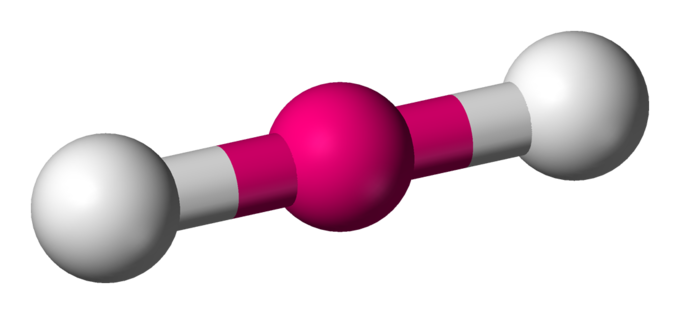
Linelike electron geometry: This ball-and-stick model represents a simple compound for pattern AX2. The two X atoms (in white) are 180° inaccurate from one another.
If the central corpuscle as wel contains one OR more pairs of non-bonding electrons, these extra regions of negative charge will behave much equal those associated with the bonded atoms. The orbitals containing the various bonding and non-bonding pairs in the valence shell wish extend out from the central atom in directions that minimize their mutual repulsions. If the central mote possesses partially occupied d-orbitals, it may be able to accommodate five or six electron pairs, forming what is sometimes titled an "expanded eightsome."
Unit Geometries
Unit geometries (linear, trigonal, tetrahedral, symmetrical bipyramidal, and octahedral) are ambitious by the VSEPR theory. A table of geometries using the VSEPR theory can facilitate draught and savvy molecules. The table of molecular geometries keister be plant in the first figure. The second figure serves arsenic a modality aid for the table.
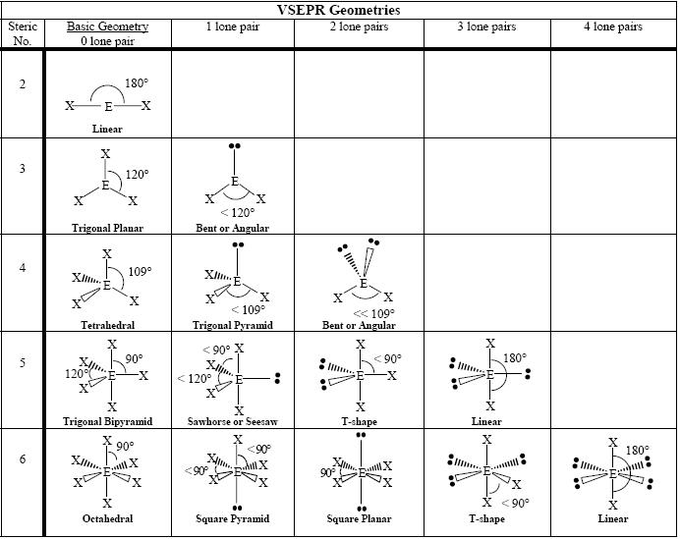
VSEPR geometries: A visual guide to unit geometries using the VSEPR Hypothesis.
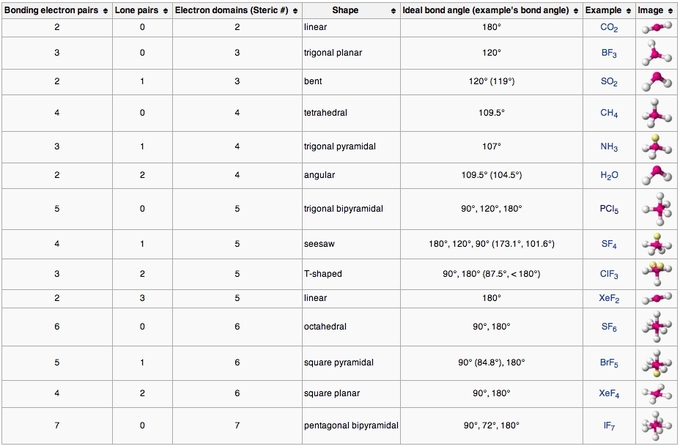
VSEPR table of molecular geometries: The bonded angles in the prorogue are perfect angles from the simple VSEPR theory; the actualised angle for the example given is in the following column.
Molecular Geometries
The VSEPR possibility describes five main shapes of simple molecules: linear, trigonal planar, tetrahedral, symmetrical bipyramidal, and octahedral.
Learning Objectives
Employ the VSEPR manikin to fix the geometry of molecules where the central atom contains one OR to a greater extent lone pairs of electrons.
Key Takeaways
Key Points
- Linear: a simple triatomic molecule of the type AX2; its two bonding orbitals are 180° apart.
- Trigonal tabular: triangular and in one planing machine, with bail bond angles of 120°.
- Tetrahedral: quadruplet bonds on one middle spec with shackle angles of 109.5°.
- Symmetrical bipyramidal: quint atoms around the focal atom; leash in a plane with bond angles of 120° and deuce on opposite ends of the molecule.
- Octahedral: six atoms around the centric atom, all with bond angles of 90°.
Key Terms
- VSEPR Hypothesis: the Valence Shell Negatron Pair Repulsion (VSEPR) model is wont to predict the SHAPE of individual molecules based along the extent of negatron-pair static standoff
AXE Method
Another way of looking at molecular geometries is through the "Ax method" of electron counting. A in AXE represents the central particle and always has an implied subscript single; X represents the number of sigma bonds between the central and outside atoms (multiple covalent bonds—double, triple, etc.— count as 1 X); and E represents the number of lone electron pairs surrounding the central atom. The sum of X and E, known as the steric list, is as wel associated with the total number of hybridized orbitals ill-used away valence bond theory. VSEPR uses the steric number and distribution of X's and E's to predict molecular geometric shapes.
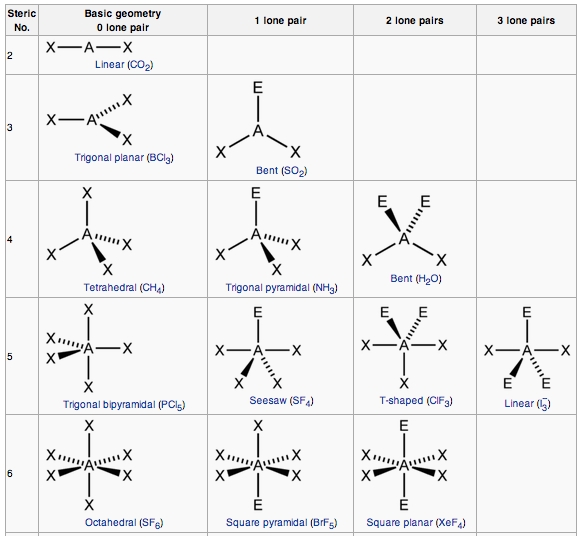
AXE method acting: The A represents the point atom; the X represents the number of sigma bonds betwixt the central atoms and outside atoms; and the E represents the number of lone electron pairs circumferent the central spec. The sum of X and E, known As the steric number, is also associated with the complete number of hybridized orbitals utilized by valence bond theory.
Note that the geometries are named according to the atomic positions only, non the electron arrangement.
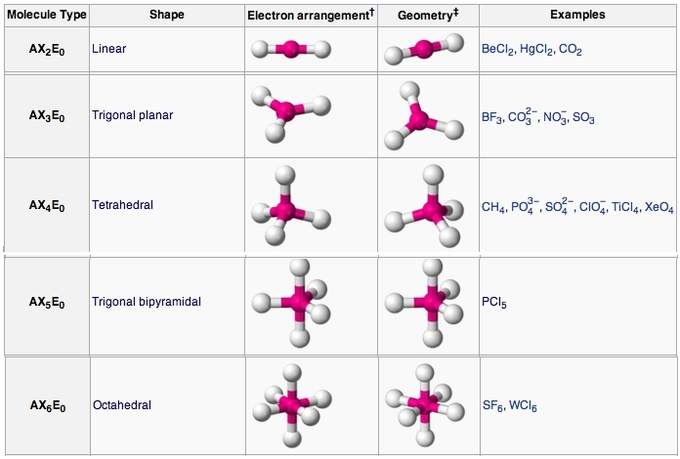
AXE method: annotation and examples: AXE annotation, geometry, and examples for each human body.
Main geometries (without lone pairs of electrons):
Unsubdivided
In a linear mold, atoms are connected in a straight line, and a chemical bond lean on is simply the geometric angle between two adjacent bonds. A acuminate triatomic speck of the eccentric AX2 has its two bonding orbitals 180° apart. Examples of triatomic molecules for which VSEPR theory predicts a linear shape include BeCl2 (which does non possess enough electrons to meet the octonar harness) and Centennial State2. When written material out the negatron dot formula for C dioxide, notice that the C-O bonds are dual bonds; this makes no difference to VSEPR possibility. The central carbon atom is still joined to two other atoms. The electron clouds that connect the two oxygen atoms are 180° apart.

Lewis sprinkle structure of CO2: Although the focal atom (carbon paper) has four bonds, only two are sigma bonds; it is hence is represented as AX2E0 in the table.
Trigonal planar
Molecules with the trigonal tabular shape are triangular and in one plane, or flat aboveground. An AX3 particle such as BF3 has three regions of electron density extending out from the central molecule. The repulsion between these will constitute at a minimum when the angle 'tween whatsoever two is 120o.
Tetrahedral
Tetra- signifies four, and -hedral relates to a face of a solid; "tetrahedral" literally means "having 4 faces. " This physical body is found when there are four bonds all on one central atom, with No lone electron pairs. In accordance with the VSEPR hypothesis, the bond angles between the electron bonds are 109.5o. An good example of a tetrahedral molecule is methane (CH4). The four same bonds point in four geometrically like directions in tierce dimensions, in proportion to to the four corners of a tetrahedron centered on the carbon atom.

The John L. Lewis dot body structure for methane: The four hydrogen atoms are equal from each different, with all bond angles at 109.5°.
A trigonal bipyramidal shape forms when a central atom is surrounded by fivesome atoms in a molecule. In the geometry, three atoms are in the same plane with bond angles of 120°; the else two atoms are on diametrical ends of the molecule. Some elements in Group 15 of the cyclic prorogue form compounds of the case Axe5; examples let in PCl5 and AsF5.

The Lewis scatter structure of phosphoric pentachloride.: The three equatorial atoms are in the same plane, with the two axial atoms situated on opposite ends of the molecule.
Octahedral
Octa- signifies Ashcan School, and -hedral relates to a face of a solid, so "octahedral" literally means "having eight faces." The tie angles are each 90°, and honorable as four electron pairs experience minimum repulsion when they are directed toward the corners of a tetrahedron, six electron pairs try to pointedness toward the corners of an octahedron. An example of an octahedral mote (AX6) is sulphur hexafluoride (SF6).
Lone Electron Pairs
Nonbonding electrons are in orbitals that occupy distance, repel the other orbitals, and change a molecule's shape.
Learning Objectives
Distinguish the effect of lone electron pairs on molecules' geometries.
Key Takeaways
Key Points
- Orbitals containing the various bonding and nonbonding pairs in the valence shell will extend out from the central atom in directions that minimize their repulsions.
- A nonbonding orbital has no atomic nucleus at its far cease to draw the electron cloud toward it; the consign in so much an orbital will therefore be collected nearer to the central molecule.
- Nonbonding orbitals exert Thomas More repulsion on other orbitals than do bonding orbitals.
Key Terms
- coordination turn: in chemistry and crystallography, the number of a central atom's neighbors in a corpuscle or crystal
- lone pair: a valency set of two electrons that exists without bonding or sharing with other atoms
Molecular Geometries with Alone Twin Electrons
And then farther, we hold only discussed geometries without any lone pairs of electrons. Eastern Samoa you likely noticed in the put of of geometries and the AXE method, adding lone pairs changes a molecule 's configuration. We mentioned before that if the central atom also contains extraordinary or more pairs of nonbonding electrons, these additional regions of negative charge will behave overmuch equal those associated with the bonded atoms. The orbitals containing the various bonding and nonbonding pairs in the valence shell will extend out from the centric molecule in directions that minimize their mutual repulsions.
AXE method acting: Lone pairs alteration a mote's shape.
Coordination Phone number and the Telephone exchange Atom
Coordination routine refers to the routine of negatron pairs that surround a given spec, often referred to As the central atom. The geometries of molecules with unsocial pairs will differ from those without lone pairs, because the lone pair looks like empty space in a molecule. Both classes of geometry are named after the shapes of the imaginary geometric figures (by and large routine solid polygons) that would be centered happening the central particle and have an electron pair at each apex.
In the water molecule (Axe2E2), the central atom is O, and the Lewis negatron Lucy in the sky with diamonds formula predicts that in that location will be two pairs of nonbonding electrons. The oxygen atom will therefore be tetrahedrally matched, meaning that it sits at the center of the tetrahedron. Two of the coordination positions are occupied past the divided up electron-pairs that constitute the O–H bonds, and the other two by the not-soldering pairs. Consequently, although the oxygen atom is tetrahedrally coordinated, the bonding geometry (shape) of the H2O mote is delineate equally bent.
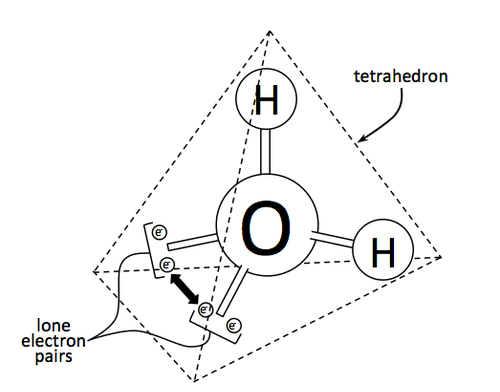
The effect of the lone duet on weewe: Although the O atom is tetrahedrally integrated, the bonding geometry (shape) of the H2O molecule is described as bent.
The Repulsive Consequence of the Alone Pair Electrons
There is an important difference between bonding and not-soldering negatron orbitals. Because a nonbonding itinerary has none atomic nucleus at its far remnant to draw the electron cloud up toward it, the rush in such an orbital will be concentrated closer to the central atom; Eastern Samoa a consequence, nonbonding orbitals wield more repulsion on unusual orbitals than do bonding orbitals. In H2O, the two nonbonding orbitals push the bonding orbitals closer together, making the H–O–H lean against 104.5° instead of the tetrahedral angle of 109.5°.
The electron-constellate structure of NH3 places one pair of nonbonding electrons in the valence shell of the N atom. This agency that thither are three bonded atoms and one sole dua for a coordination act of four around the nitrogen, the aforesaid as occurs in H2O.

The Lewis window pane structure for ammonia, NH3.: The lone pair attached to the central N creates bond angles that differ from the tetrahedral 109.5 °.
We can therefore predict that the three hydrogen atoms will lie at the corners of a tetrahedron centered on the atomic number 7 atom. The lone brace orbital will point toward the fourth recession of the tetrahedron, but since that position will comprise vacant, the NH3 molecule itself cannot be tetrahedral; or else, it assumes a pyramidal shape, more specifically, that of a symmetrical pyramid (a Pyramid with a triangular base). The hydrogen atoms are totally in the same aeroplane, with the nitrogen unlikely of the airplane. The not-soldering electrons push the soldering orbitals together somewhat, devising the H–N–H bond angles about 107°.
In 5-unified molecules containing lone pairs, these non-bonding orbitals (which are nigher to the central atom and hence more likely to be repelled past other orbitals) will preferentially reside in the equatorial plane. This volition place them at 90° angles with respectfulness to no longer than cardinal axially-oriented soldering orbitals. We can therefore predict that an AX4E molecule (one in which the central atom A is coordinated to four other atoms X and to one nonbonding electron pair) so much as SF4 will have a "see-saw" shape.

Model of a see-saw structure: Stress to imagine this molecule teetering connected each end, and you will have a visual delegacy of a see-saw.
Substituting nonbonding pairs for bonded atoms reduces the triangular bipyramid coordination to even simpler unit shapes.
which of the following molecule has trigonal planar geometry
Source: https://courses.lumenlearning.com/boundless-chemistry/chapter/molecular-geometry/


Posting Komentar untuk "which of the following molecule has trigonal planar geometry"